

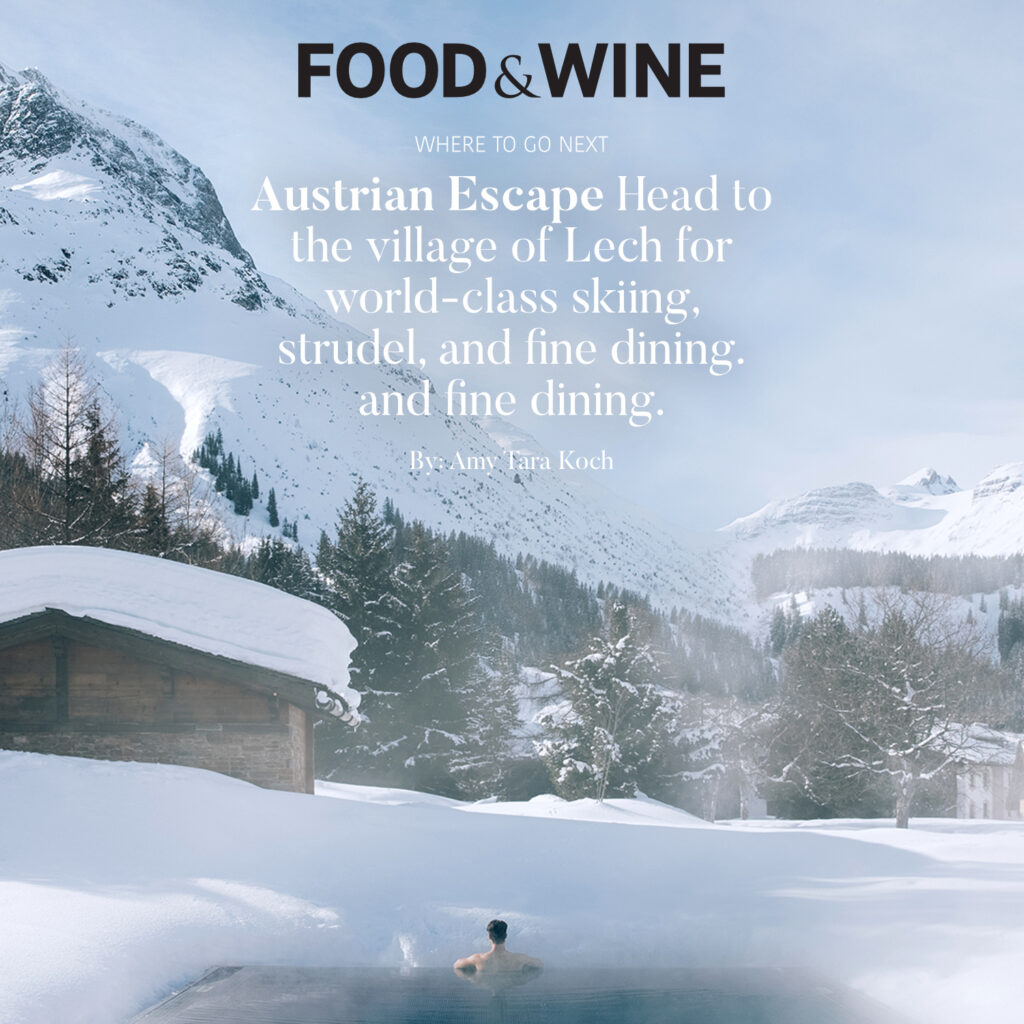
I would not have predicted that a five-mile trek in shin-high snow, through the Spullerwald forest, over rivers, past ice-fringed firs to a rustic hut, would be a highlight of my trip to Lech.
But, when a white-out storm axed the day’s ski program, I hiked to Alpele for a skillet of Tiroler Gröstl (a bacon, onion, and potato fry-up similar to hash) washed down with Grüner Veltliner. That lunch in a fire-warmed, 300-year-old room in the shadow of the Rufikopf mountain crystallized what had drawn me to the Austrian Alps: commitment to alpine heritage.
Here, there are no chain hotels, branded pop-ups, celebrity chef concept restaurants, or lookalike boutiques. In fact, the chocolate-box town with its medieval onion-domed church is as classic as it was when Princess Diana taught Harry and William to ski there in the 1990s. Shops and restaurants are locally owned, some operated by descendants of the farming families who settled the town in the 14th century. Lodging is family-run, often with staff dressed in traditional boiled wool jackets with an upturned collar or dirndls. Along the river, you’ll see parents pulling children on old-fashioned sleds. This time-capsule charm is what draws travelers back to the same hotel—and often the same room—year after year.
Food here is also tethered to tradition. Forget flown-in salmon or Japanese wagyu. In these mountains, menus feature regionally sourced meat, freshwater fish, locally foraged root vegetables and wild mushrooms, and cheese from cows that spend the summer grazing in the surrounding valleys. And despite its remote and diminutive size, somehow, this hamlet of 1,500 residents is home to more than 50 restaurants. There is a magical hut culture and plenty of gastronomy, including two spots with Michelin stars and 56 awarded toques by the French dining guide Gault & Millau. In contrast to the glitz and cookie-cutter resorts elsewhere in Europe, I found all of this wildly attractive. But having just five days to take all of this in was a bit nerve-racking. I’d have to eat and ski strategically.
Each morning, as the sun exploded over the snow-kissed chalets, I leaped from my eiderdown cocoon to enjoy a lavish breakfast spread of meats (speck, weisswurst sausage), marinated and smoked fish, Bergkäse cheeses, Birchermüsli-topped yogurt, and rye farmhouse bread. The early start and carb loading were essential to tackle even a fraction of the 200 miles of terrain at my disposal (Lech, St. Anton, St. Christoph, Stuben, Zürs, Warth, and Schröcken are gondola-linked and can be skied with one Ski Arlberg pass).
Traversing Lech’s vast, cruisy groomers was exhilarating. And exhausting. My ski guide, Tamara Hochreither, suggested the perfect pick-me-up: apfelstrudel. “Are you sure? I don’t want to ruin my appetite,” I said, which elicited a hearty laugh from my local friend. “Don’t worry. You will be starving in two hours.” We clicked out of our skis at Kriegeralpe, a typical Skihütte, and tucked into cinnamon-flecked apple strudel swimming in warm vanilla sauce. She was right. Ten runs later (and a shot or two of lingonberry schnapps), I easily polished off my Wiener schnitzel.
Skiing The White Ring, a circular route that connects the towns of Lech, Zürs, Zug, and Oberlech, offers easy access to modern huts like Balmalp and Der Wolf, for raclette, vegan stews, polenta with stewed fruit, and blistered pizzas eaten on wraparound terraces. As you schuss back into town, you can pop into Schneggarei for cocktails and charcuterie. Though it’s not a hut, the outdoor, disco ball-adorned Eisbar is another on-piste watering hole where skiers congregate for Glühwein.
On-the-slope huts are for lunch (except Schneggarei), but there are a few historic ones open for dinner well worth a twilight run. Both Hus Nr. 8, which dates to the late 1700s, and Hospiz Alm St. Christoph, which originated as a 14th-century shelter for travelers crossing the Arlberg Pass, deliver cozy, lost-in-time ambiance and stick-to-your-ribs classics, think fondue, Kässpätzle, hand-cut noodles tangled with caramelized onions and cheese, and tafelspitz, the classic boiled beef with apple-horseradish.
Those seeking more global flair will find it at Marile, where 33-year-old chef Rick Frank pairs Austrian mountain ingredients with Japanese verve, sending out dashi foam-topped egg custard in onion tea laced with caviar.
When the Michelin Guide returned to Austria in 2025 after a 15-year hiatus, it awarded two stars to Chef’s Table at Rote Wand, where 31-year-old Julian Stieger constructs a tasting menu that feels as spry as the millennials operating the kitchen. The meal kicks off in an ancient schoolroom with bubbly and bites (smoked eel and elderberry choux; a potato flour dumpling infused with crispy wild boar skin and crème fraîche) and moves upstairs to a horseshoe-shaped counter where diners can observe dishes being prepared. Regionality is such a point of pride for Stieger that he includes an intermission of sorts between appetizers and dinner to showcase ingredients and explain where and how his team procured them.
“The 17 or so courses are from what we grow in our garden (and preserve), forage, or are sourced from regional producers. Even the truffles and eel are local,” explains Stieger, who was also awarded the Michelin Young Chef Award.
Away from the dining rooms, the local butcher Hagen’s serves leberkäse (a style of meatloaf) on a fresh semmel roll, enjoyed in the adjacent locals-filled café. The newly opened Arlberg Club House is part of a three-story hat tip to “the good mountain life,” serving Mediterranean-veering fare in a stylish timber-shingled room.
Family-owned hotels contribute to Lech’s charm and are just as critical to its culinary scene. Far from being farmed out, buzz-building enterprises, hotel restaurants are conduits for owners to connect guests to their passion for this snowy corner of Austria. Marile, inside Der Berghof, is the vision of owner Isabelle Burger, who introduced the au courant stube last season. “Local artisans produced all of the woodwork and embroidery,” Burger shares proudly. The taxidermy-filled Post Lech Hotel, owned for generations by the Moosbrugger family, pours small-batch Grüner Veltliner in a bar guarded by a stuffed ibex shot by the owner’s mother and serves elaborate fondue meals in a Jägerstube, or old-world hunting lodge.
At Almhof Schneider, a converted farmhouse that has been in the same family for 600 years, current owners Gerold and Katia Schneider present their own version of alpine chic by juxtaposing weathered wooden beams, antique furniture, and patinated brass with contemporary art, à la a super-sized metallic antler sculpture and dramatic Walter Niedermayr photos. At the stunning restaurant, Wunderkammer, you’ll feast on Fiaker goulash (a Viennese variation of the Hungarian classic) and Riesling beuschel (offal ragout) under a coffered ceiling ablaze in psychedelic plants painted by artist Paul Renner.
I watched Gerold advise guests on their ski plans and chat with them throughout the day, and commented on how his presence fostered a special intimacy.
“Of course, we are a business, but this has been home to my family for more than 600 years,” he says. “Our hotel is built on relationships; 95 percent of our guests return because they feel a special connection to our hotel and Lech.”
I will definitely be one of those 95 percent.
SIDEBAR
WHERE TO EAT
Rote Wand Hotel’s Chef’s Table
Inside, you’ll find a 17-course fine dining experience inside a historic schoolhouse, with just 14 seats. Expect dishes like juniper-smoked sturgeon and braised capon with mountain cheese-laced Jerusalem artichokes, a Hendrix-rich playlist, and artisanal pairings including Georgian wine. rotewand.com
Alpele
Reachable only by foot, snowshoe, cross-country ski or snowmobile, this 300-year-old hut serves alpine classics like Tiroler Gröstl and venison ragout. Evenings are all about fondue, from classic cheese to a hunter’s version with red deer and venison. lechzuers.com
Marile at Der Berghof Hotel
Marile is a bijou five-table dining room where Austrian ingredients meet global technique in dishes like char with pumpkin seed mole, or tomato tartare with shoyu sauce, mustard-scented ice cream and toasted brioche. derberghof.at
Kriegeralpe
Don’t let this rustic ski hut fool you; they have a legit wine cellar and cooking classes, and serve heaving cheese and charcuterie boards, exemplary apple strudel, and Austrian Kaiserschmarrn, a fluffy shredded pancake dusted in powdered sugar. (kriegeralpe.com)
Wunderkammer
The on-site restaurant at Almhoff Schneider servers deftly prepared Austrian classics in a traditional dining room that’s been ushered into the modern era. Don’t skip the award-winning wine list that draws from a hefty cellar. (almhof.at)
WHERE TO STAY
Der Berghof
In the center of town beside the Rüfikopf cable car, travelers will find this stylish, family-run property, which offers warm hospitality, simple rooms, and an excellent cocktail program.
(Rooms from $490 including breakfast; derberghof.at)
Almhof Schneider
Almhof is a cool, contemporary ski-in, ski-out bolthole boasting two outstanding restaurants, a spa, and a 25,000-bottle wine cellar that will delight everyone in your travel party.
(Rooms from $1,200, including breakfast and dinner; almhofschneider.com)
Gasthof Post Lech
This historic luxury hotel with traditional Tyrolean décor also offers an extensive wine list and a weekly cocktail hosted by the Moosbrugger family. (From $875; postlech.com)
0 Comments